


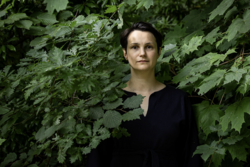
Prof. Dr.-Ing. Radostina Radulova-Stahmer (she/her)
Jade University of Applied Sciences
Department of Architecture
Ofener Straße 16/19
ZA Room 106
26121 Oldenburg
Germany
Phone +49 441 7708-3222
radulova-stahmer [at] jade-hs.de
www.jade-hs.de/regenerative-urbanism

Consultation hours: by appointment
Springer Nature — Call for Book Chapters
The major challenges of the upcoming decades — transition to
climate neutrality and mitigation, perservation of biodiversity,
addressing resource scarcity, technological disruption and digitalisation,
social inequalities and urbanisation — require a profound
social transformation from the current state of fossil-based unsustainability
to a state of post-fossil sustainability. This transformation
has far-reaching implications for urban and regional development,
for example in terms of land use, mobility and energy supply. Our
series of publications addresses challenges and opportunities for
action with an approach that combines theory and practice.
In this first volume of the series, we will focus on the broad spectrum
of topics addressed and are looking for forward-looking contributions
from science and practice that open up new conceptual
perspectives and point to pathways for transformation.
While the primary focus lies on Europe, we also welcome contributions
from other regions that — despite differing contexts — are
connected by shared questions of sustainable futures. The volume
seeks to explore design-oriented, governance-related, and strategic
dimensions of sustainable spatial development at different scales,
integrating perspectives on spatial-functional quality, institutional
steering, and social, ecological, and economic resilience. Possible
contributions may address, for example, circular approaches in
urban and regional development, the role of digital transformation
for resilient cities, brownfield development as a pathway to
climate-neutrality, or the governance of land and housing for the
common good. Equally relevant are questions of urban mobility
transitions, biodiversity as a guiding planning principle, new forms
of suburbanity, or the transformative potential of migration, integration,
and multilocal living.
Contributions shall make a new contribution to the field of research
— conceptual, methodological/data-based, design/prototype-
based, governance-related or related to the systemic impact.
Submission Guidelines
• Length of abstracts: 1.000 to 3.000 characters including spaces
(excluding references)
• Submission format: Please send the abstracts as a PDF and Word
file in an e-mail with the header – TSR – Abstract to Mohamed
ElGamal, Dr.-Ing. mohamed.elgamal@uni-rostock.de
• Length of full papers: 10.000 to 30.000 characters including
spaces (excluding references)
• Meaningful figures are appreciated.
Timeline
• 30 April 2026: Deadline for the submission of abstracts
• 31 May 2026: Feedback from the editors on the abstracts
• June–July 2026: Writing phase for authors
• 31 July 2026: Deadline for the submission of the full papers
• 31 August 2026: Feedback from the editors on the full papers
• September–October 2026: Revision of the full paperss by the
authors, if necessary
• 31 October 2026: Deadline for the submission of the revised full
papers
• 30 November 2026: Delivery of the manuscript to the publisher
• Beginning of 2027: publication
Editors
• Prof. Dr. Hendrik Jansen, University of Rostock, Germany
• Dr. Mohamed ElGamal, University of Rostock, Germany
• Prof. Dr. Jan Matthias Stielike, Jade University of Applied Sciences,
Oldenburg (Oldb.), Germany
• Prof. Dr. Radostina Radulova-Stahmer, Jade University of Applied
Sciences, Oldenburg (Oldb.), Germany
The book series is published with Springer Nature. We invite scholars
and practitioners from urban studies, planning, governance, and related
disciplines to contribute to this interdisciplinary volume.
Download Call for Book Chapters