


Prof. Dr.-Ing. Radostina Radulova-Stahmer (she/her)
Jade University of Applied Sciences
Department of Architecture
Ofener Straße 16/19
ZA Room 106
26121 Oldenburg
Germany
Phone +49 441 7708-3222
radulova-stahmer [at] jade-hs.de
www.jade-hs.de/regenerative-urbanism

Consultation hours: by appointment
International Scientific Symposium 2026
ON SITE (STREAMED ONLINE)
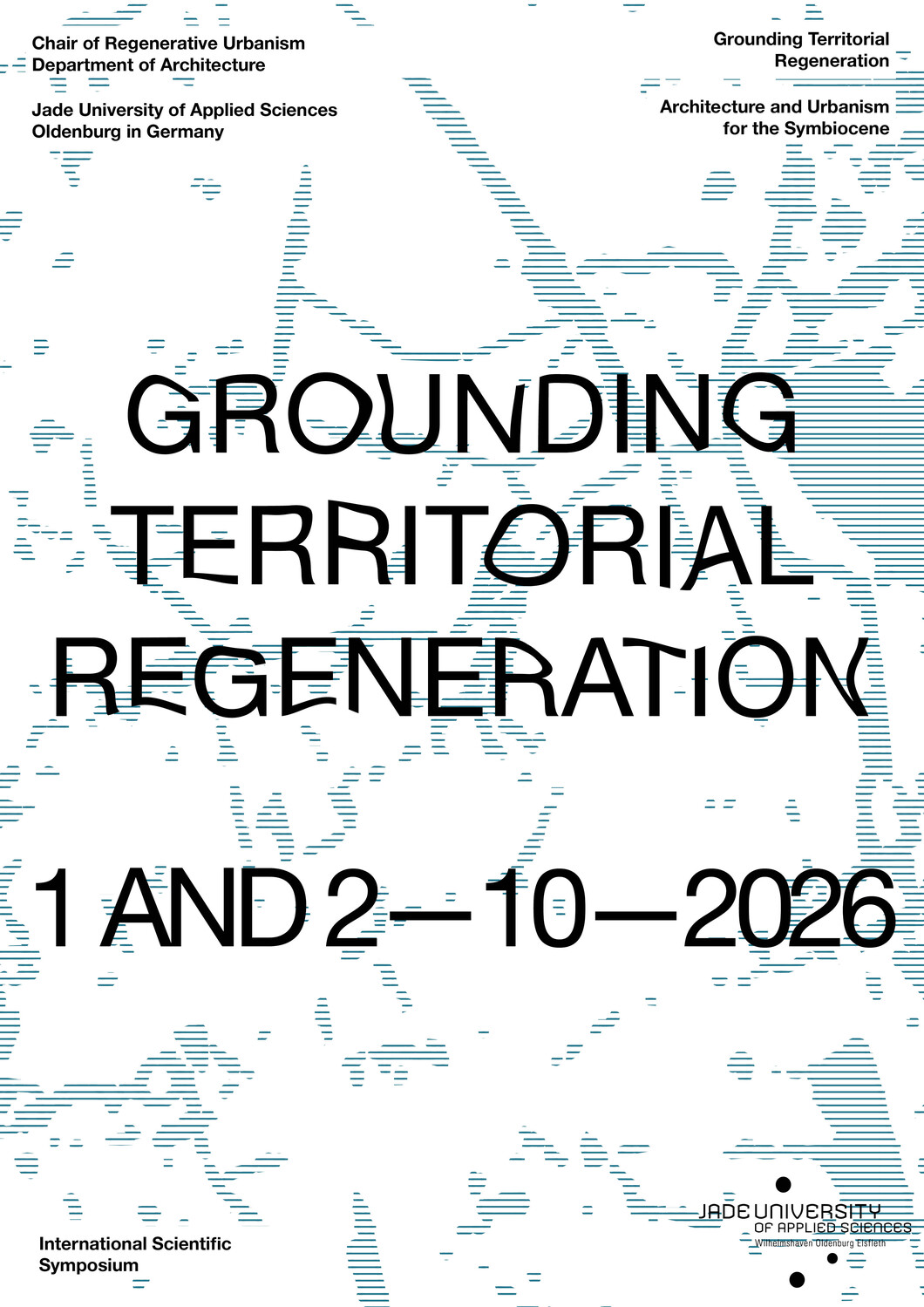
Grounding Territorial Regeneration — Architecture and Urbanism for the Symbiocene
Chair of Regenerative Urbanism, Jade University of Applied Sciences
Oldenburg, Gernamy, 1—2 October 2026
We are entering an age in which architecture and urbanism are asked to “regenerate” territories at unprecedented speed: retrofit water systems under hydrological volatility, rebuild soil functions within agro‑industrial landscapes, decarbonize material cycles under resource constraints, and govern digital infrastructures that increasingly shape planning decisions. Too often, regeneration is framed as optimization—measurable, project-bound, and scalable—while its externalities are displaced to other territories, other communities, and future time horizons.
Grounding Regenerative Urbanism starts from a different premise: damage, loss, and ecological limits are permanent conditions, and regeneration must therefore shift from intervention and short-cycle performance to long-term, accountable responsibility within contested living territorial systems.
The purpose of the Symposium Grounding Territorial Regeneration is to establish an international forum for scholars, designers, and researchers whose work engages with territorial regeneration under conditions of ecological crisis, technological disruption, and socio-spatial inequality. It aims to create a space for presenting and critically discussing research and design practices that rethink regeneration as a grounded, relational, and long-term process.
The symposium brings together perspectives from architecture, urban design, landscape architecture, planning, geography, and related fields, with particular attention to the implications of biosphere crisis, soil, water, commons, and disrupting technologies such as artificial intelligence for the evolving role of spatial practice.
The symposium will be held in person (and streamed online) on 1—2 October 2026 in Oldenburg, Germany. It is conceived as a platform for sustained debate, knowledge exchange, and the formation of new alliances around the urgent task of territorial regeneration.
The Symposium defines Territorial Regeneration broadly, referring to the spatial, ecological, social and technological systemic qualities of territories across cities, regions, agglomerations, and other landscapes in the urban rural continuum. It describes a qualitative and systemic shift in which territorial design and planning actively restore, enhance, and regenerate ecological and social capacities, making territories net-positive over time.
The symposium emphasises territorial systems as both the subject and medium of territorial regeneration, situating design and urbanism within the complex forces that continuously shape and reshape territories.
The Symposium is organized by the Chair of Regenerative Urbanism at Jade UAS under direction of Prof. Dr. Radostina Radulova-Stahmer and Ass.-Prof. Dr. Stefano Tornieri.
Editorial Statement
Why now?—Because architecture and urbanism are operating beyond ecological, social, and epistemic thresholds where mitigation, optimization, and project-based solutions can no longer address the scale, speed, and irreversibility of territorial transformation.
Why here?—Because Oldenburg exemplifies an ordinary but highly entangled territory shaped by water, soil, energy, and agro-urban systems, foregrounding regeneration as a grounded, material, and conflictual practice rather than a speculative or iconic exercise.
PARTICIPATION IN THE CONFERENCE
● Full attendance is required
● The Scientific Committee double-blind peer reviews all full papers
● English is the conference's working language
REGISTRATION
● Participation in the symposium is free of charge
● Participation requires presentation of a paper
● Registration (online): 15—30 March 2026
PUBLICATION
● It is expected that a selection of the conference papers will be published in an book format, making accessible the output to a wider audience
● The selected papers will undergo a standard double-blind peer-review process.
● A book of abstracts is also planned for publication before the symposium.
Here is the Call for Papers and futher informations about the Submission.